Need ac repair services in Hamel?
Tell us what your heating or cooling system is doing. Marionaval Heating & Air will connect you with an independent local provider who can talk through next steps.
No obligationRequest an estimate from a local provider
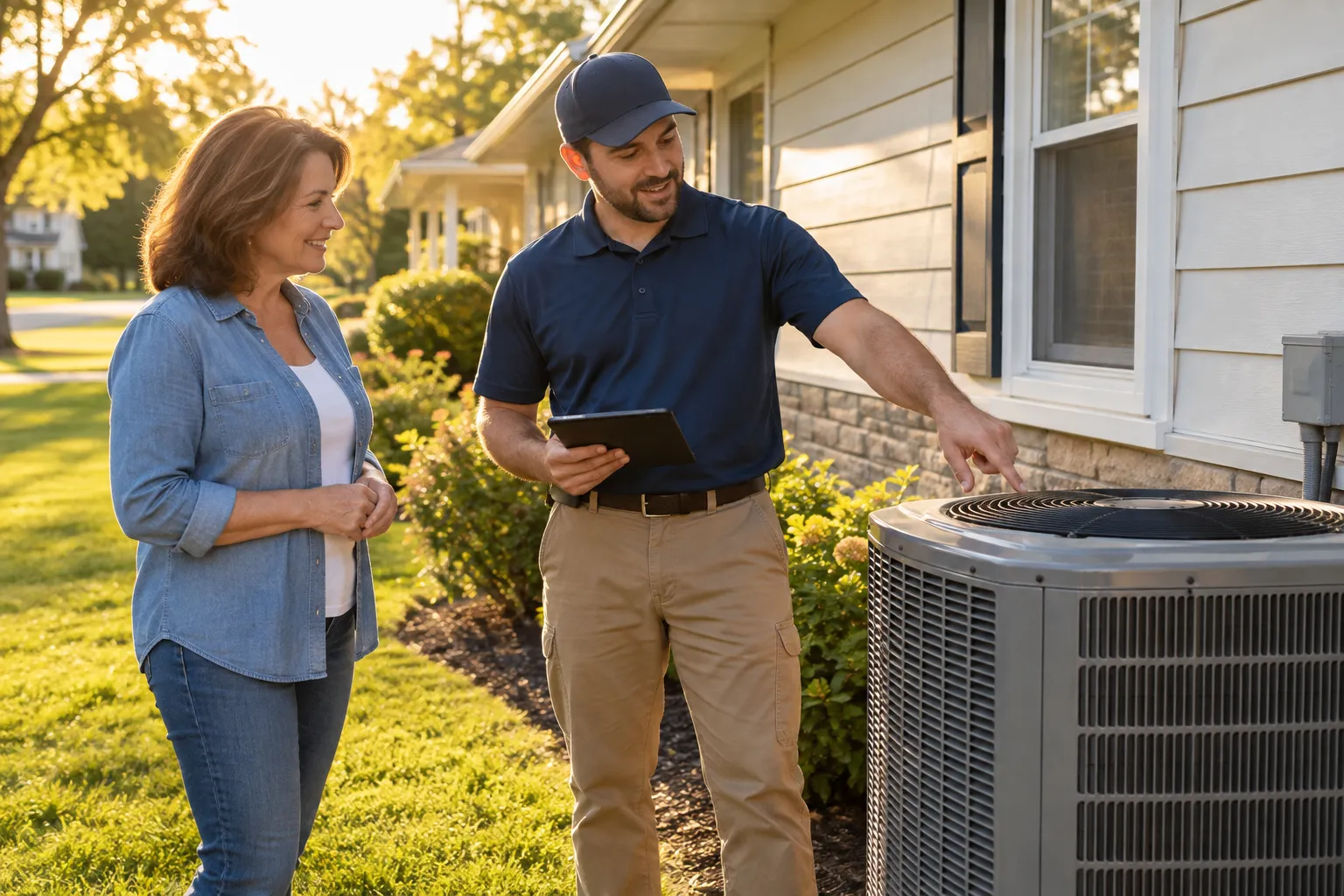
A lot of people think a warm house means the whole AC is dead and needs replacing. In practice, many cooling problems come from small parts like a capacitor, a clogged drain line or a dirty coil. A trained provider can usually tell you which it is during one visit.
Marionaval Heating & Air is a referral service. We do not repair air conditioners. We help homeowners in Hamel and the Hamel area get their photos and notes in order, then connect them with independent local providers in our network. You get a clearer conversation, better questions to ask, and a written quote before any work begins.
A common belief says that if the fan is running, the AC is fine. In practice, a unit can hum for hours and still blow lukewarm air. Humid summers in the Hamel area make this feel urgent fast, so a calm plan helps.
Check that the thermostat is set to cool and the batteries are fresh. Look at the breaker panel for a tripped switch. Slide out the air filter and see if it is gray and packed with dust. Make sure outdoor vents and the unit are not buried in leaves or grass clippings.
The fact is that AC cabinets hold stored electrical charge and refrigerant lines. Stop at the safe checks above. Leave panels, wiring and refrigerant to a licensed provider.
Not every warm room is an emergency. Some situations are, though. Burning smells, smoke, sparking, water near electrical parts, or a unit that keeps tripping the breaker all call for shutting the system off at the thermostat and the breaker.
Many people assume it means a truck at the door in minutes. Availability depends on the provider and the weather. Request a callback to check provider availability, and say clearly if someone at home is elderly, ill, very young, or on medical equipment.
The usual clues are easy to spot once you know them.
Ice is a warning sign. It often points to low airflow or a refrigerant issue. Turn the system off and let it thaw, which can take hours. Running it frozen can strain the compressor.
A surprising number of homeowners think the provider will sort out everything on arrival. A few minutes of prep makes the visit shorter and the quote clearer. Think: notes, photos, quote.
Snap the thermostat display, the outdoor unit, the data label with model and serial numbers, any ice or water, and the breaker panel. Wide shots and close-ups both help.
Write down when the problem started, what you heard or smelled, and what you already tried. Add the age of the system if you know it, plus any past repair receipts.
Hail and severe thunderstorms can bend fins and knock out power to parts. Some policies may cover sudden damage, so check your policy. Providers can often help document damage for a claim, and your photos make that easier.
The provider usually starts by asking about symptoms, then inspects the thermostat, filter, outdoor unit and indoor coil. They test electrical parts and airflow, and may check refrigerant levels. You should hear what they found in plain words, along with options and a written quote before work starts.
Most fixes fall into a few buckets.
Refrigerant does not get used up like fuel. If it is low, there is a leak somewhere. A good provider explains where it is, or at least how they plan to find it.
People often believe any unit over ten years old must be replaced. Age matters, but so do repair cost, efficiency and how often the system has failed. When a repair bill is a large share of a new system's price, or the unit has needed repeated fixes, it is worth asking for a replacement quote too. Heating and cooling equipment that shares one set of ducts may also be worth looking at together, though a furnace is its own job.
This is the part that protects your wallet. Ask every provider the same questions so you can compare fairly.
Clear, specific and unhurried. "The capacitor tested weak, here is the part price and labor, and here is how long the repair is warranted." You should be able to repeat it back.
Be careful with pressure to decide on the spot, quotes with no itemized parts, a request for full cash payment upfront, or a refusal to show you the failed part. Vague talk about "the whole system is shot" without test results deserves a second opinion.
Gather your photos and notes, then pick the route that suits you. Request an estimate and a provider in our network will follow up, or Request a callback to talk it through.
A provider checks thermostat, airflow, electrical parts and refrigerant to find why your home is not cooling.
Worn capacitors, fan motors and contactors can often be replaced during one visit.
Clogged drain lines and dirty or frozen coils are common causes of leaks and weak cooling.
Before work starts, you should get findings explained in plain words, with options and itemized pricing.
Prices vary by system age, brand, parts and how hard the unit is to reach. These are typical U.S. ranges only. Always get a written quote that lists parts and labor before you agree to any work.
| Repair item | Typical range | Notes |
|---|---|---|
| Diagnostic visit | $75 – $200 | Some providers apply it to the repair |
| Capacitor or contactor | $150 – $450 | Common cause of a unit that won't start |
| Condensate drain line clearing | $100 – $350 | Prevents water damage and shutdowns |
| Fan motor replacement | $300 – $900 | Indoor and outdoor motors differ |
| Refrigerant leak repair | $250 – $1,600 | Depends on leak location and refrigerant type |
| Compressor replacement | $1,500 – $3,500 | Often prompts a repair-or-replace talk |
Take pictures of the thermostat, unit and data label, then jot down symptoms, sounds and when it started.
Request a callback to check availability, or send the request form with your details and details of the problem.
Ask questions, compare options and read the written quote before approving any work.
Keep your invoice and warranty details for future repairs and claims.
Learn what each symptom usually means before you talk to anyone, so you can follow the conversation and spot weak answers.
Get a short list of questions to ask and what good and bad answers sound like.
Photos, notes and past receipts help providers quote accurately and support any insurance conversation.
Connect with independent providers in your area who know cold winters, humid summers and storm season.
Tell us what your heating or cooling system is doing. Marionaval Heating & Air will connect you with an independent local provider who can talk through next steps.
No obligationCommon causes include a dirty filter, a frozen coil, low refrigerant from a leak, or a failed outdoor fan or compressor. Check the filter and thermostat first, then ask a local provider to diagnose it.
It depends on the repair price, the unit's age and its repair history. If one fix costs a large share of a new system, ask a provider for both quotes.
Take photos of the thermostat, outdoor unit and data label. Write down symptoms and when they began. Clear space around the units, and keep past repair receipts handy for the provider.
Tell us what your heating or cooling system is doing. Marionaval Heating & Air will connect you with an independent local provider who can talk through next steps.
No obligation